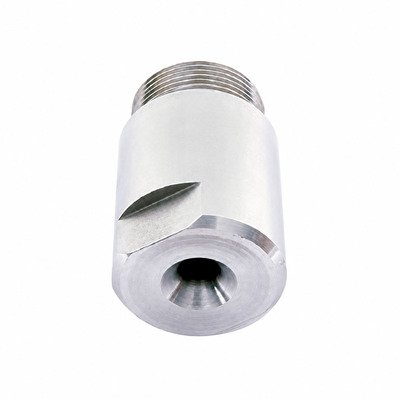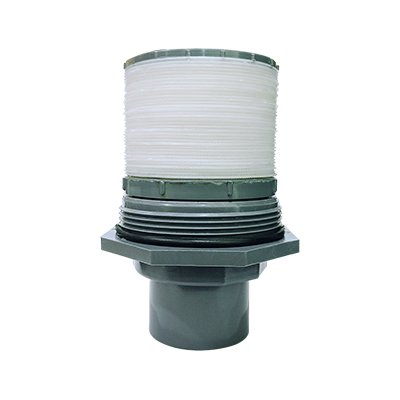

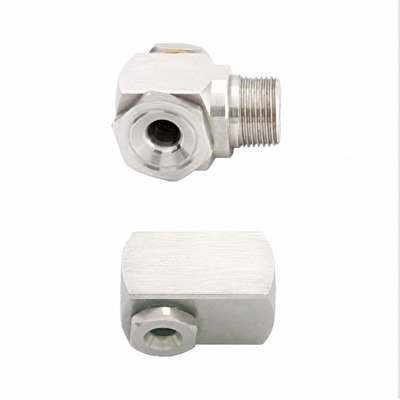
Full cone and hollow cone nozzles both produce circular spray footprints, but they distribute liquid differently. The right choice depends on where the liquid must land, how the spray interacts with the process, and the operating conditions at the nozzle.
What is a full cone spray?
A full cone nozzle distributes droplets across the interior of a circular spray area. Many designs use an internal vane or other flow-forming geometry to create the pattern. The intended result is coverage throughout the circular footprint rather than only at its perimeter.
Full cone patterns are commonly evaluated for:
- washing and rinsing;
- cooling and quenching;
- chemical processing;
- dust suppression; and
- distributing liquid over a vessel, surface, or packed area.
Actual distribution varies by nozzle design, capacity, pressure, spray distance, and liquid properties. Review the performance data for the specific model rather than treating every full cone nozzle as interchangeable.
What is a hollow cone spray?
A hollow cone nozzle forms an annular pattern: most of the liquid is concentrated around the outside of a circular footprint, with comparatively little liquid in the centre. The pattern is commonly created using tangential entry or an internal whirl chamber.
Hollow cone patterns are often considered for:
- gas cooling and conditioning;
- scrubbing and absorption;
- humidification;
- dust control; and
- processes that benefit from strong liquid-to-gas contact.
Hollow cone designs are available in different configurations, and their performance is influenced by the same system variables that affect other nozzle types.
Side-by-side comparison
| Selection factor | Full cone | Hollow cone |
|---|---|---|
| Liquid distribution | Across the circular footprint | Concentrated around the perimeter |
| Typical pattern appearance | Filled circular area | Ring-shaped circular area |
| Common process objective | Broad surface or volume coverage | Annular coverage or liquid-to-gas contact |
| Internal geometry | Often uses a vane or flow-forming insert | Often uses tangential entry or a whirl chamber |
| Centre of spray | Intentionally receives liquid | Receives comparatively little liquid |
| Selection concern | Distribution uniformity over the target | Ring placement and spray interaction |
This comparison describes the general pattern families. Individual models may use different internal designs or produce different droplet and distribution characteristics.
Does one pattern make finer droplets?
No universal rule applies to every full cone and hollow cone nozzle. Droplet size depends on nozzle geometry, orifice size, capacity, pressure, liquid viscosity, surface tension, and other conditions.
If atomization is a critical requirement, compare model-specific test data at the intended operating point. Do not select a pattern based only on a general assumption about droplet size.
Coverage and spray distance
Spray angle and distance determine the theoretical footprint, but real-world coverage can be affected by gravity, air movement, pressure, liquid properties, and nearby equipment. At longer distances, the pattern may become less defined or more vulnerable to drift.
For either pattern, verify:
- the required footprint at the target;
- the nozzle-to-target distance;
- acceptable overlap between adjacent sprays;
- obstructions and air movement; and
- whether the target or nozzle moves.
Clogging and filtration
Clogging risk is governed by the smallest internal passage, not simply the connection size. Internal vanes, whirl chambers, and small orifices can trap suspended solids or accumulated deposits.
Review the liquid’s particle size and solids loading, then specify suitable upstream filtration. The filter opening should be selected with the nozzle manufacturer’s guidance and the needs of the entire system in mind. Where deposits are expected, ensure the nozzle can be accessed for safe inspection and cleaning.
Material and wear
Erosion or corrosion can enlarge or distort an orifice, changing capacity and pattern quality. Choose a material compatible with both the process liquid and the environment, and monitor performance rather than judging condition by appearance alone.
Where abrasive solids are present, wear resistance and planned inspection may be as important as initial spray quality.
Advantages and limitations
A full cone pattern can provide liquid across the full circular footprint, which is useful for broad coverage. Its internal flow-forming components must remain clean and undamaged for the intended distribution to be maintained.
A hollow cone pattern provides an annular distribution that can support liquid-to-gas contact and perimeter coverage. It is not the right choice when the centre of the target must receive the same liquid distribution as the surrounding area.
Neither pattern is universally better. The advantage comes from matching the distribution to the process while accounting for capacity, pressure, free passage, material, and maintenance needs.
Questions to ask before selecting
- Does the process need a filled circular footprint or an annular ring?
- What flow is required at the pressure available at the nozzle?
- What spray angle and distance will place the pattern on the target?
- Are droplet behaviour, impact, or gas contact critical?
- Does the liquid contain solids or form deposits?
- Which materials are compatible with the liquid and environment?
- Can the nozzle and upstream filter be inspected safely?
Which one should you choose?
Choose a full cone pattern when the process calls for liquid throughout a circular area. Choose a hollow cone pattern when an annular distribution is the better match for the target or gas-contact duty.
Before finalizing either choice, compare the required flow, available pressure, spray angle, droplet behaviour, material, connection, free passage, and maintenance access. Testing under representative conditions remains the best way to confirm performance.